If you’ve ever looked at your marketing options and thought:
- “Google Ads is getting out of control.”
- “SEO is a long game and everyone in my market is fighting for the same keywords.”
- “Facebook works… if you’re willing to become a part-time content creator.”
…you’re not alone.
And now there’s a new variable on the board: OpenAI says it plans to start testing ads inside of ChatGPT soon. That could change how people find lawyers online in 2026.
Will it replace Google overnight? No.
Could it become a meaningful new channel for some law firms? Very possibly.
Let’s break down what’s been announced, what the early version of “ChatGPT ads” will likely look like, and what you can do now so you’re ready to test it without wasting money (or chasing hype).
What OpenAI announced
Here are the key details that matter:
1) They’re not launching ads everywhere… yet
OpenAI says it’s not launching ads everywhere immediately, but plans to start testing soon, starting in a limited way.
2) Ads are expected to start with select tiers
The early rollout is expected to be limited to certain user tiers, not across every plan from day one.
3) The first ads likely look more like “sponsored placements” than traditional ads
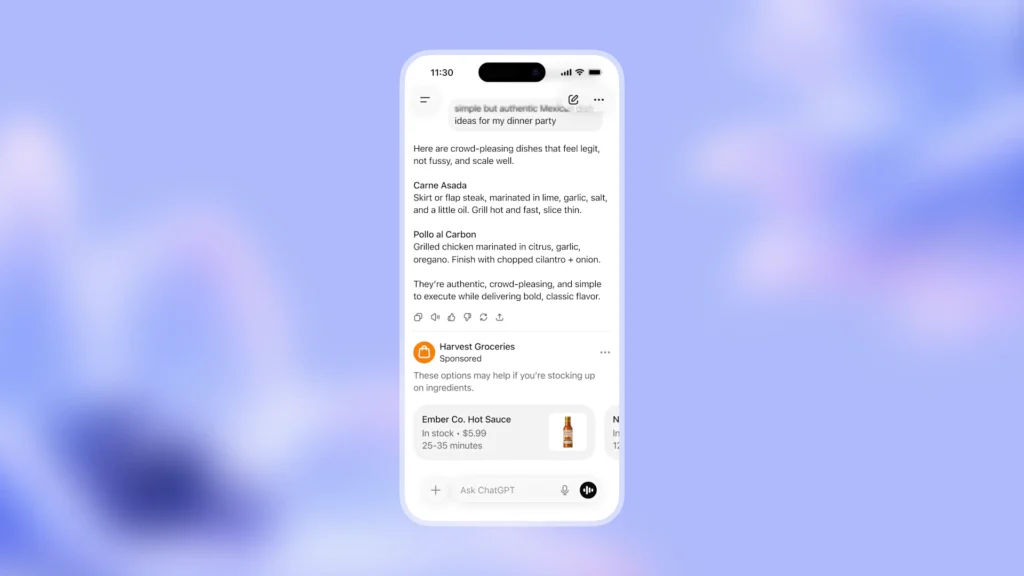
Early tests are expected to place ads at the bottom of responses when there’s a relevant sponsored product or service. Ads should be clearly labeled and separated from the main answer.
4) There are guardrails (and users get some control)
OpenAI has stated it’s building in guardrails and user controls, including limits around sensitive topics.
Why this matters to law firms
The bigger story isn’t “new place to buy clicks.”
It’s that client discovery is moving from search boxes to conversations.
People already use AI tools to ask questions they might not type into Google, like:
- “What should I do after a car accident if the other driver doesn’t have insurance?”
- “If my ex won’t follow the custody agreement, what are my next steps?”
- “Is a DUI always a criminal case?”
- “Do I need a lawyer for an immigration interview?”
Those are high-intent questions, and they’re usually asked before someone knows exactly what to search for.
If ads can show up when someone is already explaining their situation (and the ad is relevant), that could be an intent moment that looks a lot closer to search than social.
That’s the opportunity.
Here’s an example of what the first ad formats we plan to test could look like:
Will ChatGPT ads be cheaper than Google Ads?
Based on what we’ve seen after years managing Pay Per Click (PPC) and Google Local Services Ads (LSA) for law firms, there’s a very strong chance ChatGPT ads will be significantly cheaper than Google Ads at the start.
Here’s why:
- Legal is one of the most expensive ad markets out there. In many practice areas, lawyers are competing in the highest-cost auctions Google offers. That’s exactly why so many firms feel priced out of PPC and LSA.
- New ad platforms usually incentivize early adoption. When a channel launches, it needs advertisers to test it, talk about it, and create momentum. The easiest way to do that is with lower costs and less competition early on.
- The “cheap phase” doesn’t last forever. If ChatGPT ads prove they can drive leads, more firms will pile in, competition will rise, and pricing will climb, just like it did with Google over the years.
So if you’re asking, “Is this likely to be more affordable than Google in the beginning?” our answer is: almost certainly, yes.
The smarter play is to treat this like an early window: test while it’s new, measure lead quality, and scale only if the numbers make sense.
The opportunity (and the realistic limitations) for law firms
Why it could be a big deal
- A potential alternative for firms that feel priced out of Google’s auction.
- A new way to reach people earlier in the decision process.
- Potentially strong fit for consumer-facing practices where education drives leads.
Why it might not be a silver bullet
- The rollout is expected to be limited early on.
- The first ad format may be fairly simple (more like sponsored placements than full campaigns).
- Legal advertising may face extra review or category restrictions, depending on how the platform rolls out.
What we think the first “winning strategy” will look like for lawyers
If ads show up as sponsored placements, you probably won’t win with clever copy alone.
You’ll win with three things:
1) A clean match between the conversation and your service
If someone asks about a motorcycle accident, your motorcycle accident page should be the destination, not your generic homepage.
2) A landing page that builds trust fast
AI traffic tends to be research-heavy. People want clarity, next steps, and confidence.
A strong landing page usually includes:
- What cases you take (and don’t take)
- What happens next (a simple process overview)
- Trust signals (reviews, credentials, experience, associations)
- A clear call to action (call, form, text)
3) Intake that doesn’t fumble the lead
A lot of paid campaigns fail because the phone doesn’t get answered, the form reply takes two days, or follow-up is inconsistent.
If AI ads bring leads earlier in the decision process, you’ll want a fast, helpful intake flow.
A practical prep checklist
Even if ChatGPT ads aren’t fully available for every advertiser yet, you can prepare now.
Step 1: Tighten your offer (per practice area)
A lot of firms run everything to “Free consultation.”
That’s fine, but you can make it stronger without being gimmicky:
- “Same-day callback”
- “Talk to an attorney (not a receptionist)”
- “We’ll tell you your options in 15 minutes”
- “Get a clear next-step plan”
The point is to reduce uncertainty and make the next step feel easy.
Step 2: Build one real landing page per core service
If you only have time for a few, start with your top revenue services.
A strong landing page for AI-driven traffic usually includes:
- A short “here’s how we help” section
- 3–5 FAQs that mirror real questions people ask
- Trust signals (reviews, awards, memberships, local relevance)
- A simple contact section with one primary CTA
Step 3: Set up tracking like you actually want to know what happened
Before you spend money anywhere new:
- Call tracking
- Form tracking
- Dedicated landing page URLs
- Lead tagging in your CRM so you can judge quality later
Otherwise you’ll get stuck in “we got more clicks” instead of “we got more signed cases.”
Step 4: Create a basic compliance checklist for ad copy and landing pages
A safe baseline:
- Avoid guarantees (“we’ll win your case”)
- Avoid misleading superlatives you can’t prove
- Be clear about location/jurisdiction
- Be careful about what you ask on the first click
Step 5: Don’t replace your pipeline overnight
If Google LSA, Google Ads, or SEO is already working, don’t cut it off because a new shiny thing showed up.
A smarter approach is:
- Keep what’s working
- Carve out a test budget
- Measure lead quality
- Scale only if it’s actually better
What we’ll be watching as this rolls out
If you’re a law firm owner, these are the questions that will matter most as this develops:
- Are legal services included early on?
- What targeting options exist?
- How intent-driven are the leads compared to Google Search?
- Does lead quality hold up (calls vs. forms vs. tire-kickers)?
- Can we clearly connect spend to consults and signed cases?
Bottom line: This could be a real opportunity if you’re set up to convert the click
This isn’t a guarantee but it is a new door opening. The firms that benefit most are probably the ones that:
- Get their landing pages and intake tightened up
- Track properly
- Test calmly
- Don’t chase hype
Want to be first in line for early testing?
Early ad platforms are usually the most affordable before competition ramps up. If you want to be part of the first group of firms we help test ChatGPT ads (when available), we’ll put you on our short list and reach out when it’s ready. Shoot me an email at nick@pointclick.io or Schedule a free consultation today.